An Undergraduate Computer Science Major Engages in Interdisciplinary Research on Southern Ocean Phytoplankton Modeling
The Southern Ocean is a large part of the global carbon cycle and phytoplankton play a key role by converting CO2 to organic carbon, which can be transported to the deep ocean. Previous works examined phytoplankton presence and CO2 flux but didn’t take community species composition into account. The purpose of this research, funded by a PCC Research Acceleration award to P.I.’s Alison Gray and Hannah Joy-Warren, was to determine the relationship between phytoplankton community composition and carbon fluxes. As a computer science major, I was eager to join this project.
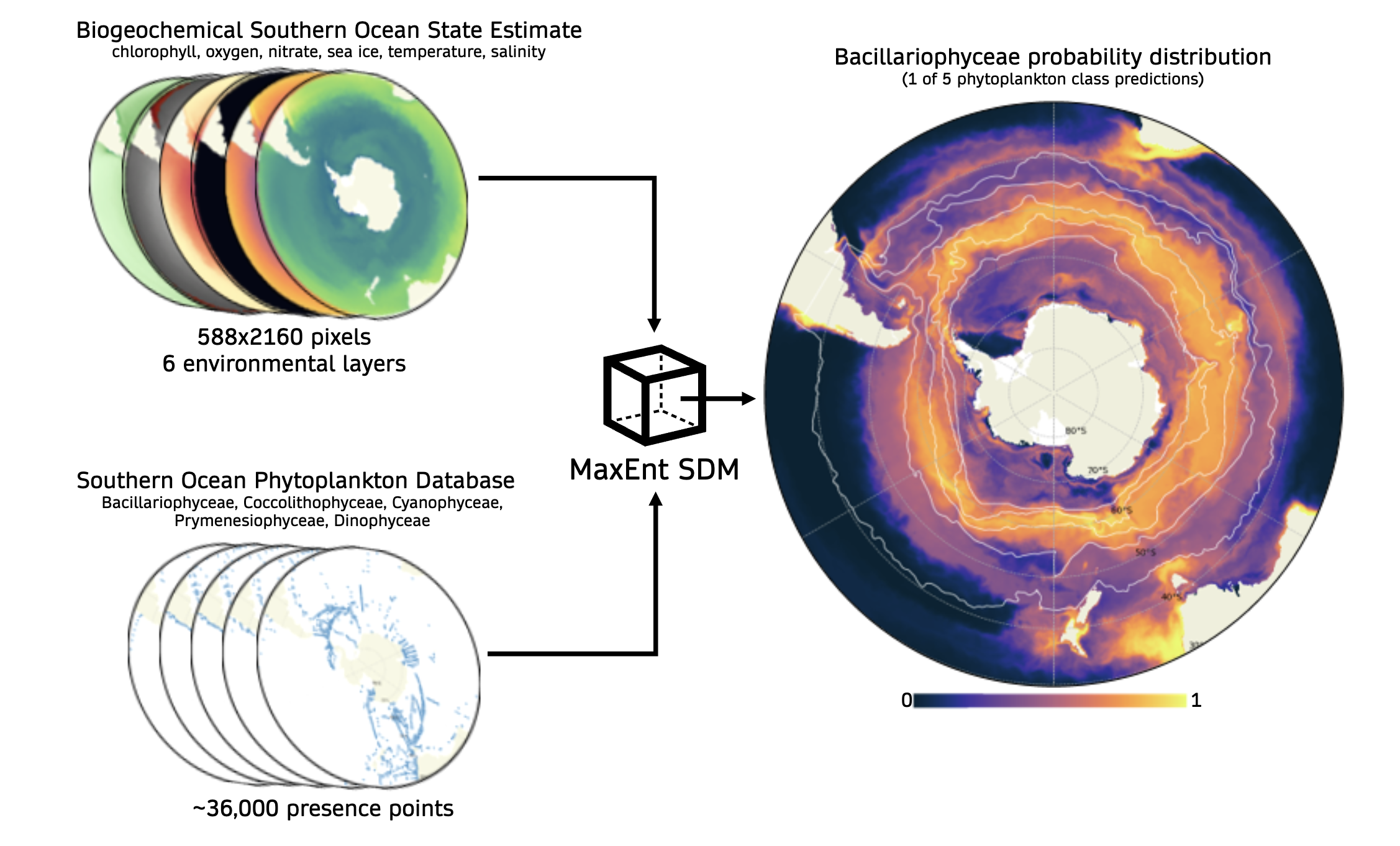
First, we compiled a database of phytoplankton species observations in the Southern Ocean. The environmental variables that we used were derived from the Biogeochemical Southern Ocean State Estimate. These estimates provide high-resolution data on physical and biogeochemical variables for the entire Southern Ocean. We computed the seasonal mean of these variables from 2013 to 2018 which allowed us to capture the seasonal differences in the habitat suitability of each species. Then the presence points and environmental layers were fed into a MaxEnt species distribution model. The Maximum Entropy (MaxEnt) SDM technique models species distributions from presence-only data. There is support for different kinds of features, such as linear, quadratic, or categorical, and includes mechanisms to account for spatial sampling bias and regularization, which prevents overfitting. This technique performs well and is widely applied in ecology and biogeography.
As a computer science major, this project became a meaningful interdisciplinary experience for me. I was able to use resources and learn from both the oceanography and computer science departments, and I distinctly remember asking my machine learning professor and TAs for advice while the ML modeling work was in progress. I also established a long-term collaboration with Prof. Dave A. C. Beck from the eScience Institute, who provided guidance on many of our data science decisions throughout the project.
One of the most satisfying moments came when a concept from my computer science coursework clicked in an oceanography context. I had learned about convolution for image processing in CSE 455: Computer Vision, and it turned out that the same idea applies to downsampling high-resolution ocean state estimate grids. Using an average filter we could efficiently reduce resolution while preserving the large-scale structure of the environmental variables.
As a computer science major, receiving this award gave me a rare opportunity to engage in oceanography and Earth science research. Because of it, I was able to present this research at multiple showcases around the University of Washington and attend the 2024 Ocean Sciences Meeting (OSM’24). This work also led into my later experiences at NASA JPL, where I completed two internships focused on improving data access patterns for NASA Earthdata on AWS and building a SWOT sea surface temperature (SST) dashboard. Overall, this experience was instrumental in shaping my skills in software engineering, data science, and open-source software development.
Written by Ayush Nag. Ayush is now a software engineer at SpaceX Starlink.